Food plots are a great way to supplement the natural carrying capacity of a given land. Food plots should average between three and six percent of the total land area; assuming that the remainder of the land provides substantial year-round food sources; including browse, hard and soft mast, and other agricultural crops. Plots should be limited to five acres maximum; with ideal size of one acre. Larger plots expose wildlife to potentially higher predation rates.
On tracts designated to timber production; losing acreage to food plots is not desirable. However, there is a solution. Logging landing areas and access roads throughout the property make great food plots. Although it can make it more difficult to locate wildlife because the plots will be spread across the entire property; it will have a minimal impact on the value of timber supported on the property.
Food plots should be designed to maximize wildlife usage, not to maximize wildlife visibility. Thus, plots are best designed in long, narrow, irregularly shaped areas with plenty of dense cover areas to serve as escape routes. This dense cover can overlap as other potential feed sources; ie. sumac, berries, coniferous browse, etc. The plots would ideally be located near some dense coniferous bedding area; especially in northern areas for late-season winter wheat and other late maturing feed sources. The plot would best be located to the side of the coniferous areas that protects it as best as possible from the prevailing winter winds; as less snow accumulation will make the plots more attractive to deer.
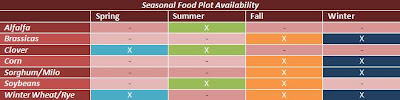
Alfalfa is a food plot plant that is very important to discuss from a financial standpoint. For the most part; many of the food plot plants that are available are going to cost you money over the long run as planting and fertilizing costs rack up. Conversely, alfalfa can typically be grown for a profit; even if you do not have the equipment to perform the task yourself. On a shared crop basis; the land owner will provide 50% of the crop to the farmer in exchange for cutting and baling. While most land owners will not have a need for the remaining 50% of the crop, it does present a potential income stream should it be sold. If 1% of the total land area is planted in alfalfa and 4% is planted in other food sources; the income from the alfalfa will offset the cost of establishing and maintaining the plots; even if only than half of the retained hay is sold. On the downside, alfalfa can be relatively difficult to establish, as it is not very tolerant of a wide range in pH levels. However, once established; alfalfa can expected to provide strong yields for upwards of five years, making it one of the most favored food plot plantings.
Brassica vegetables have recently come into favor as a food plot planting. Brassicas consist of vegetables such as broccoli, brussels sprouts, cabbage, and turnips. For the sake of food plots; turnips are the most common; especially wild turnips. Brassicas make a great fall and early winter crop; as wildlife does not consume the leaves until the first hard frost; at which point starches in the leaves convert to sugar and the leaves become more palatable.
Clover is a great all-purpose food plot crop; with high protein content and relatively early green-up in the spring. However, it does have its drawbacks; namely, it dies after any light frost; making it of minimal use as a fall and winter planting. Also, clover does not have as long of a lifespan as alfalfa; typically three years or so; although it is much easier to establish than alfalfa, so the trade-off is not that negative.
Corn requires special planting considerations because of wildlife habits. While corn cannot be beat as a winter food plot planting because of its high carbohydrates and great source as cover, wildlife tends to begin to consume it in early summer just as cobs begin to form; leaving little corn for winter feed. To deter this; there are a few solutions; first is to inter-plant soybeans with the corn; as deer will prefer the soybeans to the corn; thus alleviating the early feeding pressure on the corn. Second; corn should only be planted in large, 3+ acre plots; as anything less will encourage wildlife to consume the corn during the early summer when it is of little nutritional value. It is important to consider the cost of planting corn for wildlife feed as well; as corn consumes large amounts of nitrogen fertilizer. However, inter-planting soybeans with the corn can reduce the monetary need for nitrogen fertilizer, as soybeans are a legume that fixes nitrogen to the soil that the corn would use. Further, utilizing alfalfa as a potential income stream can make planting corn and other nutrient-demanding crops a lesser financial strain, which can be important on large land areas with substantial food plot acreage.
Sorghum, commonly known as milo, is similar to corn, as it produces seed heads which are a great winter food source for wildlife. However, like corn, it has its downsides. Through learned behavior, wildlife will begin to consume sorghum in early September, just as the seed heads begin to fully develop; as a result; wildlife will be feeding on this source when it is not necessary to do so, as other crops would be more favorable and in season. Further, sorghum does not have the nutritional benefits of corn; meaning, in choosing between the two; corn would be more favorable. However, milo would make a better food source for upland game birds, should this be the target game. Either way, sorghum should be considered only on large properties and is treated similarly to corn.
Soybeans are one of deer's most favored plant come summer. As summer begins, wildlife, namely deer, will spend a lot of time feeding on this protein-rich food source. This grazing will continue into the fall and early winter months when wildlife feed on the mature bean pods. While soybeans yield much less than alfalfa or clover; they are excellent at extracting nutrients from the soil and can withstand heavy grazing once established. One has to manage the plot carefully, however, as too heavy of grazing early on can kill the plants; thus beans should be planted as early as possible; as fawning can give the plot the time it needs to get off the ground. That said; soybeans make an excellent food plot planting to consider.
The last major food plot contender is winter wheat/rye. This fall planted crop can provide great late season forage, as well as extremely early spring green-up with proper moisture, which is important as this is a heavy stress period for wildlife. However, winter wheat/rye do not provide great summer forage as it becomes a unpalatable in late spring. Considering its ability to provide much needed nutrition during important stress periods; winter wheat/rye should not be ignored as a food plot contender. Perhaps it should be mixed with clover, to make a great all-season plot.
Below is an example of a 1,680 acre property currently for sale; I have used the satellite imagery to portray where food plots would be best located, as designated by the orange areas on the map. The prevailing winds in this area come from the west; thus food plots would be best located on the eastern side of coniferous stands, as it will limit the amount of snow accumulation, while also providing great natural cover for escape routes.


